






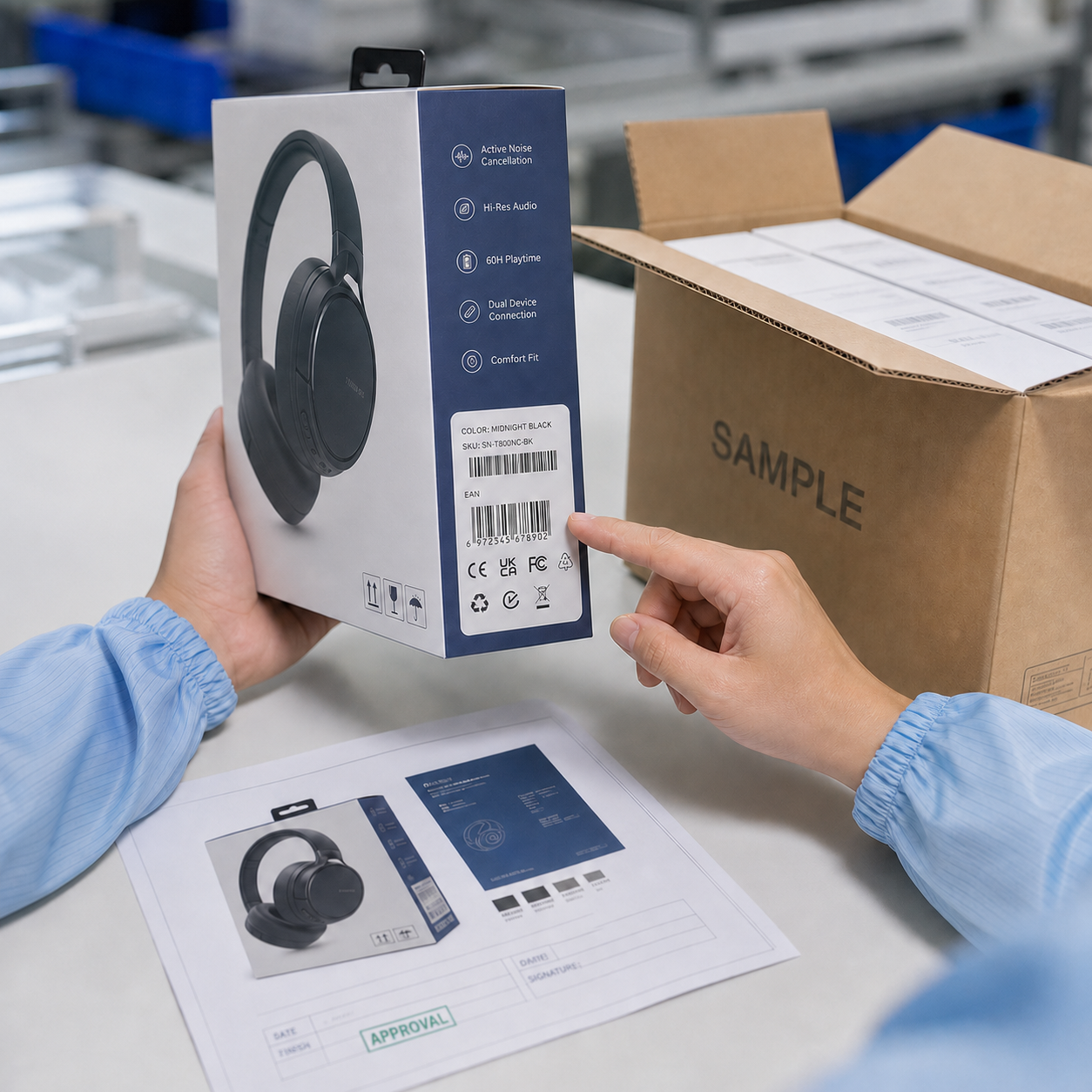
PPWR Documentation for Headphone Packaging
A TWS earbud sample may look ready for production. The artwork is approved, the inner tray fits, and the supplier says the materials are recyclable.
However, these points alone do not create a complete PPWR packaging record.
The European Commission’s PPWR guidance confirms that Regulation (EU) 2025/40 generally applies from 12 August 2026. Some technical targets will take effect later, but packaging information should already be traceable.
For an EU headphone brand, the practical question is not only which material to choose. The brand also needs to connect each approved package with its material data, drawings, test evidence, and production version.
Know the Responsible Party
Before collecting documents, buyers should confirm who holds the legal role for the packaging.
Under Regulation (EU) 2025/40, a company that has packaging or a packaged product designed or manufactured under its own name or trademark may be treated as the manufacturer. The exact role still depends on the supply chain and the exceptions in the regulation.
Article 16 also requires packaging suppliers to provide manufacturers with the information and documents needed to demonstrate conformity.
This means a Chinese OEM headphone factory can provide supporting packaging information. However, one supplier statement does not automatically transfer every EU responsibility to the factory.
Article 39 makes another important point. By drawing up the EU Declaration of Conformity, the manufacturer assumes responsibility for the packaging covered by that declaration.
Buyers should therefore confirm their role with an EU compliance adviser instead of assuming that the packaging factory or product supplier holds the complete obligation.
Build a Packaging Record
Many headphone projects begin with an artwork file. For PPWR preparation, buyers also need a component-level packaging record.
This record works like a packaging bill of materials. It identifies what each component is made from and links that component to an approved version.
| Packaging component | Information to record | Evidence to request |
|---|---|---|
| Retail carton | Paper type, unit weight, coating and dimensions | Material specification and approved drawing |
| Inner tray | Material, unit weight and mold version | Supplier statement and tray drawing |
| Accessory sleeve | Material and separation method | Material data and approved sample |
| Labels and adhesives | Material and application area | Supplier information and revision record |
Actual material descriptions are more useful than broad terms such as sustainable packaging or eco-friendly tray.
For example, recording only “paper box” does not explain whether the surface uses lamination or another coating. Recording only “recycled plastic” does not show the recycled-content basis or the source of that claim.
This is especially important for true wireless earbuds, where a small retail package may still contain several different components.
Keep Design Evidence
Annex VII of the PPWR explains what technical documentation may need to contain.
The list includes a general description of the packaging and its intended use. It also covers design drawings, manufacturing information, component materials, relevant technical specifications, assessment explanations, and test reports.
For a headphone project, the working file could include the carton dieline, inner-tray drawing, approved dimensions, material specifications, and sample photographs.
If transport tests were used to justify the structure, keep those results with the same packaging version. Not every headphone package needs the same test plan, so the evidence should match the real product and shipping method.
A material certificate may support one part of the file. It does not replace the complete technical record because it may say nothing about the package size, separation method, or final assembly.
Justify the Package Size
PPWR packaging minimisation is not only about choosing a different material.
Article 10 and Annex IV require packaging weight and volume to be reduced to the minimum necessary for its function by 1 January 2030.
The technical file should explain why further reduction could affect product protection or another valid packaging function.
For headphones, the required space might come from the cushion depth needed to stop the product moving during transport. A certain carton area may also be needed for instructions and legally required product information.
These reasons should be supported by dimensions and relevant tests. Making the box look larger or more premium is not enough by itself to justify additional packaging.
Instead of asking only whether the box can be smaller, buyers should ask what would fail if its size or weight were reduced again.
Control Every Revision
A PPWR file loses value when it describes the sample but not the product that is finally shipped.
Article 15 requires manufacturers to consider changes in packaging design or characteristics. When a change may affect conformity, the packaging may need to be assessed again.
This matters because OEM packaging often changes after the first sample. The buyer may replace the tray supplier, remove a coating, change an adhesive, or reduce the carton size.
Each approved change should create a new packaging version. The component record, drawing and supporting evidence should be updated together.
The buyer can then connect the final approved sample with the packaging used for mass production. Without this control, the technical file may describe one version while the factory ships another.
The same principle already supports reliable product manufacturing. Buyers can review Sonun’s quality assurance process to understand why approved specifications and production checks need to remain connected.
Add Evidence to the RFQ
PPWR documentation should not begin after the packaging has entered production.
In the first RFQ, identify the target EU market and planned launch date. Explain whether the project uses only retail packaging or also needs separate e-commerce packaging.
Ask the supplier to identify each packaging component and its material. Buyers should also request component weights, drawing versions, material evidence, and available test records.
Another useful question is who will update the packaging file when a supplier or material changes. This makes version responsibility clear before mass production begins.
Sonun can discuss packaging structure while developing an OEM headphone sample. Buyers can send their product and packaging requirements through the Sonun Audio contact page and ask which supporting information is available for the selected solution.
The goal is not to collect the largest number of certificates. It is to create one clear record that matches the packaging being manufactured.
This article is intended for sourcing and product-planning purposes. It does not replace legal advice for a specific company or EU market.